

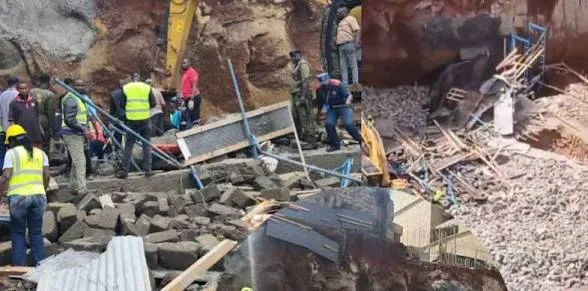
The tragedies, which occurred in Syokimau and Riverside on Friday, November 13, and Saturday, November 14, have reignited concerns over construction standards, professional supervision and the enforcement of building regulations in Kenya.
According to a report by Daily Nation, six people lost their lives after an eight-storey building under construction collapsed along Mombasa Road near the Standard Gauge Railway terminus in Syokimau on Friday morning.
The upper section of the building reportedly gave way while construction workers were carrying out their duties. Five other workers were rescued alive and taken for medical attention.
The incident was followed by another tragedy on Saturday morning when a perimeter wall collapsed at a construction site along Riverside Drive in Nairobi.
The Standard and Daily Nation reported that four workers died in the incident, while 11 others sustained injuries and were rushed to hospital.
The Riverside tragedy occurred while workers were undertaking construction activities at a site where the main building was still at the excavation and foundation stage.
Nairobi County officials indicated that investigations would examine the structural and regulatory compliance of the construction site, including whether the required safety procedures had been followed.
The latest incidents have attracted the attention of the Institution of Engineers of Kenya (IEK), which has now called for nationwide safety audits targeting high-risk construction projects.
In a statement reported by The Star on Sunday, November 15, the institution expressed concern over recurring construction-related deaths, warning that weaknesses in engineering design, construction practices, professional supervision and regulatory enforcement were putting lives at risk.
The engineers want the National Government, county governments, the National Construction Authority (NCA), the Engineers Board of Kenya (EBK) and other relevant agencies to conduct comprehensive investigations into the incidents.
IEK has also called for construction activities at the affected sites to remain suspended until the necessary safety clearances are obtained.
The institution further wants developers to engage registered professional engineers throughout the construction process and ensure that projects comply with approved designs and safety requirements.
In its preliminary assessment of the Syokimau collapse, IEK identified the temporary structures supporting the concrete slab, including formwork, falsework and vertical props, as key areas requiring investigation.
For the Riverside incident, investigators have been urged to examine the excavation support system and retaining walls to establish what caused their failure.
However, the institution cautioned that these were preliminary technical observations and that responsibility should only be established through independent investigations.
The latest developments have also raised questions about whether construction regulations are being adequately enforced, particularly in Nairobi, where building-related disasters have repeatedly claimed lives.
According to The Standard, the latest incidents come barely weeks after another devastating building collapse in Eastleigh on October 23, which claimed eight lives.
This brings the reported death toll from the three major construction disasters to at least 18 within just over three weeks.
Reuters has also previously reported concerns over poor workmanship, substandard construction materials, weak supervision and faulty structural designs as recurring factors behind building collapses in Kenya.
Meanwhile, People Daily reported that IEK wants the government to move beyond issuing statements of condolence and take concrete action to prevent further loss of lives.
With investigations expected to establish the circumstances surrounding the latest tragedies, attention is now turning to developers, construction professionals and regulatory agencies responsible for ensuring that buildings are safe.
The growing number of fatalities has placed renewed pressure on authorities to demonstrate that construction laws are being enforced and that those found responsible for negligence will face appropriate action.


Comments
No approved comments yet.