

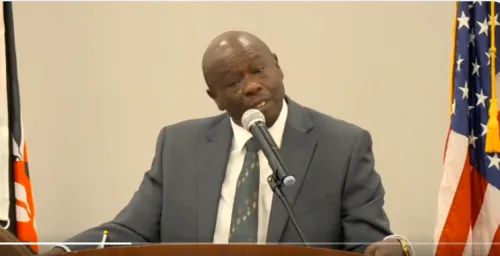
Former Deputy President Rigathi Gachagua has raised fresh concerns about Kenya's preparedness for the 2027 General Election, putting the Independent Electoral and Boundaries Commission (IEBC) under renewed pressure over its election technology arrangements.
Speaking on Sunday, November 15, 2026, during a church service at AIC Bathi in Kimende, Lari Constituency, Kiambu County, Gachagua questioned the commission's preparedness following the approaching expiry of its contract with election technology provider Smartmatic.
According to reports by Capital FM and The Star, the former Deputy President said the contract was expected to expire on November 24, 2026, warning that the commission could face complications if a replacement system was not secured in time.
Gachagua argued that procuring and implementing a new election technology system could take approximately six months, raising questions about how voter registration would continue if the existing arrangement expired before a replacement was ready.
He consequently demanded urgent consultations between IEBC, opposition representatives and other electoral stakeholders, insisting that the commission should not make critical decisions about election technology without involving political parties.
The Democracy for the Citizens Party (DCP) leader also warned that the opposition could mobilise Kenyans to demonstrate outside IEBC offices if the commission failed to agree to consultations.
In its November 15 report, People Daily further detailed Gachagua's concerns about the proposed election technology procurement involving Miru Systems, which has attracted legal challenges.
The former Deputy President questioned whether the commission had sufficient time to complete the procurement process, install the equipment and conduct the necessary tests before the 2027 elections.
His concerns come amid an ongoing procurement process involving several companies seeking to supply IEBC with an Integrated Elections Management System (IEMS).
In a November 14 report, The Star examined the controversy surrounding the procurement, including competing financial proposals, court proceedings and questions about the transparency of the tendering process.
The newspaper also reported that IEBC Chairperson Erastus Ethekon had maintained that the procurement process was ongoing and that no supplier had been selected.
The controversy has previously attracted the attention of the Public Procurement Administrative Review Board, which identified shortcomings in aspects of the original tender evaluation criteria in its September 3, 2026 decision.
However, the procurement subsequently received another opportunity to proceed following a separate decision delivered on October 14, 2026, allowing IEBC to continue with the process.
Citizen Digital, in its September 14 report on the procurement controversy, also reported IEBC's defence of its election technology arrangements.
IEBC Commissioner Alutalala Mukhwana maintained that the commission was working within the required electoral timelines and dismissed claims that the procurement process was designed to favour a particular supplier.
The commissioner also acknowledged the existence of legal challenges surrounding the procurement, urging the Judiciary to expedite the cases to avoid unnecessary delays.
Meanwhile, Gachagua has extended his criticism beyond election technology to the distribution of biometric voter registration equipment.
According to Radio 47, the DCP leader accused IEBC of favouring certain regions in the distribution of registration kits, alleging that some areas considered political strongholds of President William Ruto were receiving preferential treatment.
He demanded equal access to voter registration services, particularly in Mt Kenya, Western, Coast, Nairobi and Kisii regions.
He also raised concerns about delays in the issuance of national identity cards, arguing that young Kenyans could encounter difficulties registering as voters if the situation was not addressed.
These allegations have not been independently established, and IEBC's position on the specific accusations should be distinguished from the claims made by the opposition leader.
Interestingly, the commission's own Election Operation Plan for 2025–2027 provides an important perspective on the matter.
According to the official document published on the IEBC website, continuous voter registration is scheduled to run until May 13, 2027, while another phase of enhanced continuous voter registration is scheduled to take place between January 11 and February 9, 2027.
The document also outlines the commission's preparations for the inspection and auditing of the voters' register ahead of the August 10, 2027 General Election.
This means the commission has an established registration timetable, although questions surrounding the continuity of its election technology arrangements remain a subject of political and public debate.
With the November 24 Smartmatic contract deadline approaching, attention is increasingly turning to how IEBC intends to manage its existing technology arrangements while completing the procurement of a new system.
For Gachagua and other opposition leaders, the central demand is greater transparency and consultation.
For IEBC, the challenge is to demonstrate that its procurement decisions, voter registration arrangements and preparations for the next General Election are progressing within the required legal and constitutional timelines.
The coming days could therefore prove important in determining whether the commission provides further clarification on the concerns being raised as Kenya moves closer to the 2027 General Election.


Comments
No approved comments yet.