

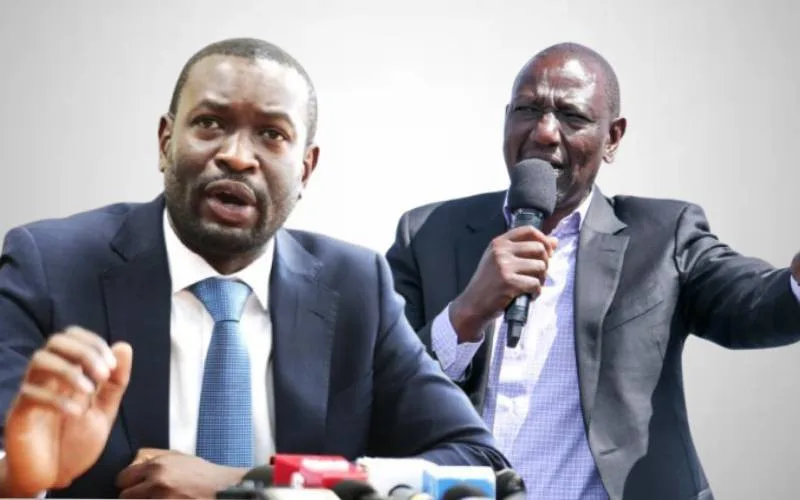
President William Ruto and Nairobi Senator Edwin Sifuna have intensified their political confrontation over the country's leadership, with the two leaders presenting contrasting messages to young Kenyans ahead of the 2027 General Election.
The latest exchange has brought the question of generational leadership into the centre of the political debate, with Sifuna warning that another Ruto presidency could delay the ambitions of young politicians seeking to take over leadership positions.
In its November 11 report, Citizen Digital revealed that Sifuna had challenged young Kenyans against re-electing Ruto, arguing that doing so would jeopardise their chances of becoming national leaders in 2032.
Speaking during a press conference in Laikipia County, where his Linda Mwananchi Movement received defectors from the Orange Democratic Movement (ODM), Sifuna delivered a direct warning to young voters.
"Nataka kuwaambia vijana wote mkichagua Ruto tena hakuna kijana atakuwa kiongozi 2032," Sifuna said.
The Nairobi Senator also criticised the government's development record, particularly the long-delayed Nanyuki-Doldol road project.
He accused successive administrations of making promises about the road without delivering the expected results and pledged that his movement would prioritise its construction.
Daily Nation, in its November 10 coverage, reported that Ruto had also addressed the question of generational leadership during his development tour of the Gusii region.
The President urged young Kenyans to support his administration, accusing opposition leaders of frustrating emerging politicians because they feared being overshadowed by younger leaders.
Ruto promised that the older generation of politicians would eventually leave the political stage in 2032 to allow younger leaders to take over.
He also defended politicians allied to his administration, including Sylvanus Osoro, Kimani Ichung'wah, Ndindi Nyoro and Aaron Cheruiyot, whom he accused Gachagua and other opposition figures of targeting.
The Star, in its November 10 report, also highlighted Ruto's remarks, including his promise to stand with younger politicians as they pursue their leadership ambitions.
The President's message has, however, drawn a different response from Sifuna, who believes young Kenyans should not be asked to postpone their political ambitions until 2032.
The disagreement has also attracted comments from senior government officials seeking to persuade Sifuna to abandon his presidential ambitions in favour of supporting Ruto's re-election.
The Star, in its November 9 report, revealed that Interior Cabinet Secretary Kipchumba Murkomen had urged Sifuna to shelve his presidential ambitions and support Ruto in 2027.
Murkomen argued that supporting the President for another term would give the Luhya community a better opportunity to produce a presidential candidate in 2032.
He maintained that Sifuna's decision to challenge Ruto could undermine the region's political bargaining power in the next succession contest.
Meanwhile, The Standard, in its November 11 political coverage, reported that Prime Cabinet Secretary Musalia Mudavadi was intensifying efforts to mobilise Western Kenya behind Ruto's re-election campaign.
The publication noted that Mudavadi's mobilisation efforts were facing resistance from the opposition movement led by Sifuna, whose Linda Mwananchi campaign has been gaining political attention across Western Kenya.
The same political disagreement was highlighted by KTN News in its November 11 coverage, which reported Sifuna's response to Mudavadi's position on asking young Kenyans to wait until 2032 for leadership opportunities.
Sifuna's growing political ambitions have also attracted attention from other established leaders, with the debate increasingly revolving around whether Western Kenya should support Ruto's second-term bid or pursue its own presidential ambitions.
The confrontation presents a significant political challenge ahead of the 2027 elections, particularly as both government and opposition leaders seek to attract younger voters.
With Ruto defending his administration's record and promising a generational transition in 2032, Sifuna is positioning himself as an alternative voice arguing that young Kenyans should not have to wait another five years to participate in national leadership.
The question now is whether Ruto's promise of a leadership transition in 2032 will convince young voters or whether Sifuna's message of immediate political change will gain greater support ahead of the next election.


Comments
No approved comments yet.