
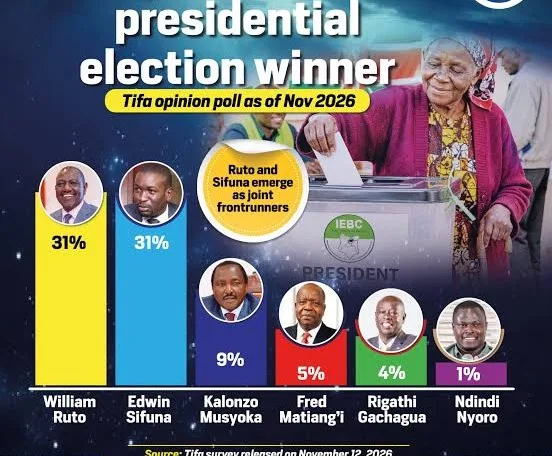
The latest survey by Trends and Insights For Africa (TIFA) places the two politicians at 31% each when respondents were asked who they would like to win the next presidential election.
The findings were released on Thursday, November 12, 2026, and have attracted attention because Sifuna is yet to emerge as the opposition's officially agreed presidential candidate.
According to TIFA Research's published findings, Ruto and Sifuna are followed by Wiper Party leader Kalonzo Musyoka, who commands 9% support.
Former Interior Cabinet Secretary Fred Matiang'i follows with 5%, while former Deputy President Rigathi Gachagua has 4%. Kiharu MP Ndindi Nyoro recorded 1%.
The survey also found that 15% of respondents remained undecided, while 2% indicated that none of the listed candidates was their preferred choice.
Daily Nation, in its November 12 report, confirmed the findings, highlighting the significant movement in the presidential preference ratings of Ruto and Sifuna.
The publication reported that Ruto's support had increased from 24% in June 2026 to 31% in November.
Sifuna's rise was even more pronounced. He had recorded 10% in May and 15% in June before reaching 31% in the latest survey.
The Star, in its November 12 coverage, also reported the results, showing how the two politicians had moved ahead of established opposition figures in the latest national presidential preference ratings.
The findings indicate that Sifuna's growing support has coincided with declining ratings for several opposition politicians who previously featured prominently in presidential preference surveys.
According to TIFA, Kalonzo's support has fallen from 25% in November 2025 to 9% in the latest survey.
Matiang'i, who recorded 32% in August 2022, has also dropped to 5%.
Gachagua's rating has similarly declined from 9% in May 2026 to 4% in November.
People Daily, in its November 12 report, highlighted another important finding from the survey: the possibility of Sifuna becoming a significant figure in the opposition's search for a joint presidential candidate.
However, the research firm cautioned that the combined support for opposition politicians should not automatically be assumed to belong to Sifuna or any other candidate.
The survey also examined political party preferences, revealing further changes in the country's political landscape.
The United Democratic Alliance (UDA) emerged with 25% support, followed by the Linda Mwananchi Movement/TEP at 17%.
The Orange Democratic Movement (ODM) recorded 10%, down from 20% in the June 2026 survey.
Nairobi Law Monthly, in its November 12 report, also highlighted the changes in party support and the growing political significance of the Linda Mwananchi movement.
The publication noted that the movement's 17% rating placed it ahead of ODM in the latest party preference findings.
The survey was conducted between October 26 and November 5, 2026, through face-to-face interviews involving 2,036 Kenyan adults across all 47 counties.
TIFA reported a margin of error of approximately 2.16 percentage points.
The research firm cautioned that the findings represent public preferences during the survey period rather than a prediction of the eventual election outcome.
The latest figures introduce fresh questions about the direction of Kenya's opposition politics, particularly as different political leaders continue positioning themselves ahead of the 2027 General Election.
With Ruto and Sifuna recording identical national preference ratings, attention will now turn to how political alliances, candidate selection and voter preferences develop in the months leading to the elections.



Comments
No approved comments yet.