

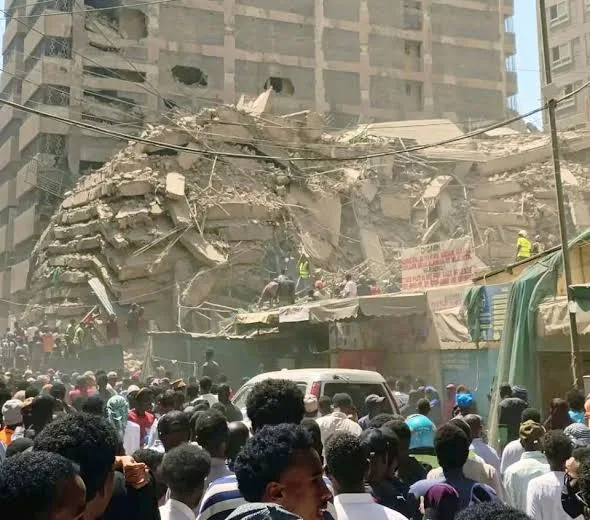
Nairobi Governor Johnson Sakaja said the structure had received construction approval but lacked the certificate required before occupation, raising concerns about how the ground-floor premises came to be used while construction continued above them.
The building collapsed at about 1pm on Friday, October 23, along Yusuf Haji Avenue, near Day to Day Supermarket on 9th Street. Rescue teams worked through the debris as authorities sought to establish how many people remained trapped.
The disaster has put the spotlight on the roles of the building's owner, construction professionals and regulatory authorities in ensuring that buildings comply with approved plans and safety requirements.
Sakaja questions how the building came to be occupied
Speaking at the scene, Sakaja drew a distinction between permission to construct a building and permission to occupy it.
“Of course, it had approval. That is not in doubt. But the steps that are being taken are what we need to question,” Sakaja said, according to The Standard.
He emphasised that receiving construction approval does not give a developer permission to open premises before obtaining the required occupation certificate.
“Before anybody gets an occupation certificate, you're not allowed to get into that property. At all. Even temporarily, that is not allowed,” he said.
The governor's remarks raised questions about whether the relevant requirements were observed before businesses began operating on the ground floor.
Reports indicated that the premises included an electronics shop, a butchery and a grocery business, even as construction continued on the upper floors.
However, the absence of an occupation certificate does not by itself establish why the building collapsed. Investigators will need to determine whether structural defects, construction practices, inadequate supervision or other factors contributed to the failure.
Police target possible negligence as owner sought
Police said investigations would examine the circumstances surrounding the collapse and establish whether anyone should face criminal responsibility.
Nairobi Regional Police Commander Issa Mohamed warned that those found culpable would be held accountable.
“Investigations will be carried out,” Mohamud said, according to the Associated Press. “We'll make sure people face the law for any negligence.”
Kenyans.co.ke reported that authorities had launched a search for the building's owner, who had not presented himself to police at the time of publication.
The investigation is expected to examine the building's approval records, construction arrangements and the responsibilities of those who designed, supervised and carried out the work.
Any decision to prosecute would depend on the evidence gathered and the applicable law. The collapse alone does not establish that a particular individual committed an offence.
Sakaja raises concerns over professional supervision
The governor also questioned construction practices in which developers allegedly obtain approvals through qualified professionals before removing them from projects.
He urged professionals who are dismissed after securing approvals to alert regulators and county authorities rather than allow projects to continue without proper oversight.
“We are appealing to all professionals that once you are given an approval and later fired, you must report to the regulators as well as the county government, because from the look here it appears like there was no professional on site,” Sakaja said, according to Kenyans.co.ke.
The allegation raises an important issue for investigators: whether the professionals responsible for the project remained involved during construction and whether the work followed the approved structural plans.
Investigators will also need to establish whether the necessary inspections were conducted and whether any concerns were raised before the building collapsed.
Those questions cannot be answered conclusively without examining the relevant records and obtaining responses from the parties involved.
Construction worker describes moments before collapse
The speed of the collapse left workers scrambling to escape.
Joseph Kaula, a plasterer who had been working on the fifth floor, told the Associated Press that he heard screams and saw other workers rushing out after realising the building was collapsing.
“I was the last person to walk out before it collapsed and the whole area was filled with dust,” Kaula said.
He suspected that some of his colleagues could have been trapped in the basement.
The account offered a glimpse of the danger faced by workers at the site, although the total number of people inside the building had not been established.
The Associated Press reported that one injured woman had been rescued and taken to hospital. Other people were feared trapped beneath the rubble as emergency teams continued their search.
Rescue teams face difficult search operation
Rescue personnel from several agencies were deployed to clear the debris and reach possible survivors.
The operation involved emergency responders, security agencies and the Kenya Red Cross, with excavators and other equipment used to move heavy concrete.
The work was complicated by concerns that the damaged structure could collapse further and by the difficulty of reaching spaces beneath the rubble.
Authorities urged members of the public to stay away from the site to allow rescue teams to operate safely.
The number of people missing, trapped or injured remained subject to official confirmation as the operation continued.
The records investigators need to examine
The central question now is not simply whether the building had approval, but whether the required safeguards were observed throughout its construction and before its premises were occupied.
Investigators will need to establish who owned the property, which plans were approved, who supervised construction and whether the completed work matched the authorised design.
They should also examine the inspection history, the involvement of qualified professionals and the circumstances under which ground-floor businesses began operating without an occupation certificate.
Nairobi County and the relevant construction regulators should explain what their records show, whether inspections took place and whether any compliance concerns were raised.
At the time of the reports reviewed for this article, the technical cause of the collapse had not been conclusively established.
The absence of an occupation certificate is an important compliance issue, but it should not be treated as proof that the missing certificate caused the structural failure.
What the Eastleigh collapse means for Nairobi
The disaster has renewed concerns about the safety of buildings in Nairobi's densely populated commercial neighbourhoods, where construction sites can sit alongside shops, homes, workplaces and busy pedestrian routes.
The incident also highlights the importance of distinguishing between approving a building and ensuring that it remains compliant throughout construction.
If the investigation identifies breaches of approved plans, inadequate supervision or failures by responsible authorities, the findings should be made public and appropriate action taken.
For now, families are waiting for answers about people who may have been trapped, while investigators face the task of establishing how the collapse happened and whether it could have been prevented.
The most consequential outcome will be a clear account of what failed, who was responsible for each part of the approval and construction process, and what measures will be taken to reduce the risk of another disaster.



Comments
No approved comments yet.