

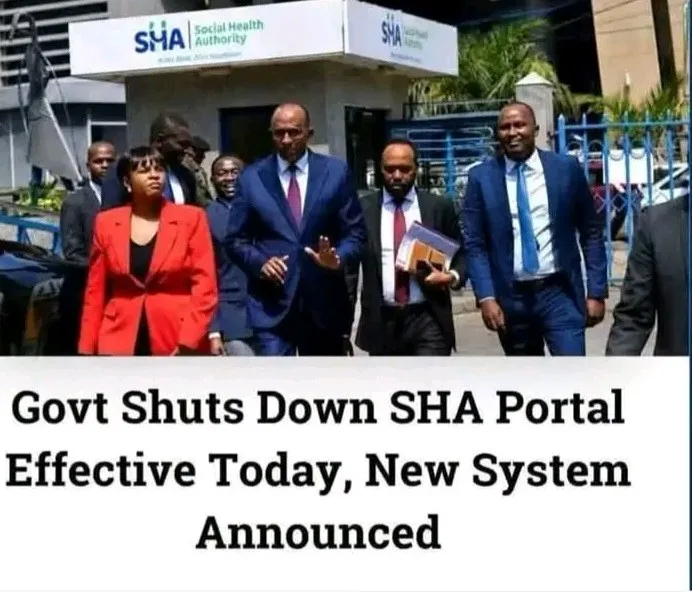
Confusion has emerged among Kenyans following the government’s decision to move health facilities from the Social Health Authority (SHA) Provider Portal to the Health Management Information System (HMIS). Health Cabinet Secretary Aden Duale has clarified that the change affects the digital system used by hospitals to manage patient information and submit claims, and does not mean that SHA is being abolished.
Citizen Digital reported that the Ministry of Health extended the migration deadline to October 30, 2026, giving facilities that had not completed the process more time to move from the SHA Provider Portal to HMIS. The extension affects public Level 5 and 6 hospitals, faith-based facilities and private health facilities that are still completing the transition.
The Ministry of Health has described the migration as part of the government's wider digital-health transformation under Taifa Care. In an official statement, the ministry said SHA HMIS is designed to support real-time patient verification, electronic claims processing, digital provider authentication and secure exchange of health information between healthcare facilities and SHA.
The change has caused confusion among some members of the public because of the planned phase-out of the Provider Portal. Kenyans.co.ke reported that the ministry clarified that SHA itself is not being replaced, but that hospitals are being moved to an integrated digital system that connects their own HMIS platforms with SHA and other health-sector systems.
Under the new arrangement, hospitals will continue using their own HMIS for daily operations while connecting those systems to SHA. People Daily reported that the previous system required healthcare facilities to use their own HMIS alongside the separate SHA Provider Portal, which could require staff to enter or transfer similar information between different systems.
The Ministry of Health says the new arrangement is intended to eliminate that duplication. People Daily reported that the integrated system is expected to reduce repetitive data entry, improve the quality of health information, strengthen claims verification and allow claims to be generated from information captured during the delivery of healthcare services.
The migration has already been completed in thousands of lower-level public health facilities. Citizen Digital, citing Ministry of Health figures, reported that all 6,427 public Level 2 to Level 4 facilities had completed the transition to HMIS.
The process is still ongoing in higher-level facilities. The Star reported that four of the 27 public Level 5 facilities had completed the migration, while the remaining 23 were at different stages of the process and are expected to complete the transition by October 30.
Faith-based facilities are also being supported as they move to the new system. KBC reported that 518 contracted faith-based facilities are being supported with HMIS installation and migration, with 38 having completed the process and the remaining facilities expected to finish by the new deadline.
The transition also covers national referral hospitals. KBC reported that Kenyatta National Hospital and Kenyatta University Teaching, Referral and Research Hospital were expected to complete their migration shortly, while other Level 6 facilities have until October 30 to meet the requirements.
Private hospitals are part of the process as well. The Star reported that the Digital Health Agency had certified 28 HMIS platforms used by private health facilities, allowing compliant systems to connect with the country's wider digital-health infrastructure.
The government has also sought to reassure patients that the transition should not affect access to medical services. People Daily reported that Duale said no patient would be denied healthcare because a facility had not completed its migration to HMIS.
The Kenya News Agency reported that Duale has urged healthcare providers, SHA, the Digital Health Agency, national referral hospitals and regulators to work together to resolve outstanding issues before the October 30 deadline. The ministry is continuing to provide technical support to facilities that have yet to complete the transition.
The HMIS migration is taking place alongside a separate SHA provider-contracting process. The Ministry of Health said the 2026–2029 HAKIKA contracting framework is being implemented through an electronic platform intended to improve transparency, claims processing, payment predictability and clarity between SHA and healthcare providers.
For SHA members, the key point is that the HMIS transition does not amount to the cancellation of SHA membership or contributions. Instead, the government is changing the digital infrastructure used by healthcare facilities to record patient information and interact with SHA.
The transition will therefore continue throughout October, with October 30, 2026, serving as the extended deadline for facilities that have not completed the required migration. The Ministry of Health says the Digital Health Agency will continue offering technical support as hospitals and other healthcare providers complete the process.Start writing your story…



Comments
No approved comments yet.