

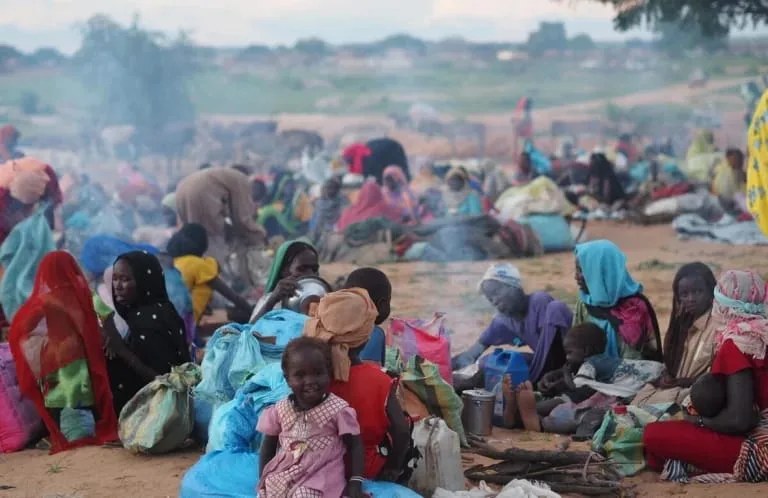
The conflict has killed nearly 200,000 people, according to estimates, while the United Nations says that more than 14 million people have been forced to flee their homes, and more than 30 million others are suffering.
The international community is intensifying its efforts to end the war, but diplomatic moves have failed to bring the fighting to a halt.
The crisis continues with no clear prospect of an end, while army chief Abdel Fattah al-Burhan has affirmed that the war will continue.
Growing Concerns Over Prohibited Weapons
Concerns are mounting in Sudan amid growing reports of the use of prohibited weapons in the war between the army and the Rapid Support Forces.
Human rights warnings indicate that indiscriminate attacks are threatening thousands of lives and worsening their suffering.
In this context, chemical weapons were used during the war by the army, while the United States imposed sanctions on Sudan.
Washington called on the Port Sudan authorities to submit a comprehensive declaration of their chemical programmes and allow unrestricted international inspections.
Sudan has been a State Party to the Chemical Weapons Convention since 1999.
All States Parties have agreed to disarmament by destroying any chemical weapons stockpiles and production facilities they may possess, as well as any chemical weapons they may have left in the past on the territory of other States Parties.
Credible Evidence
In this context, 18 experts said in a letter published on Tuesday, 29 September 2026, that evidence emerging since May 2025 strongly supports the accusation that the Sudanese army used chemical weapons during the war in Sudan.
They outlined ways to verify the allegations through the Organisation for the Prohibition of Chemical Weapons (OPCW), as calls for an independent international investigation grow.
Army chief Abdel Fattah al-Burhan denies the allegations.
The letter was prepared by Gregory Koblentz, director of the Biodefense Graduate Program at George Mason University, and published by the Center for Arms Control and Non-Proliferation.
Its signatories include Robert Mikulak, former US ambassador to the OPCW; Paul Walker, head of the Chemical Weapons Convention Coalition; and Daryl Kimball, executive director of the Arms Control Association, alongside academics and former inspectors and non-proliferation experts.
The experts affirmed that “the evidence that has emerged since the United States accused Sudan, in May 2025, of using chemical weapons strongly supports the accusation.”
According to the sources and reports on which they relied, chlorine-filled cylinders were used in at least two attacks in September 2024, and a stockpile of aerial bombs designed to disperse chlorine gas was produced.
“These remain allegations that require an investigation to verify them.”
They noted that “options available to the Organisation for the Prohibition of Chemical Weapons include investigating the alleged use, sending a technical assistance mission, or conducting a ‘challenge inspection’ of Sudanese facilities suspected of being linked to chemical weapons, pursuant to Article IX of the Chemical Weapons Convention.”
This means inspecting specific facilities to verify the suspicions.
The importance of the Convention lies in the fact that it does not merely call for an investigation in general terms.
It specifies the nature of the alleged use, the number of incidents, the type of munitions, and the legal and technical avenues available to the Organisation to verify them.
Continued Pressure
About a week ago, US Senator Chris Van Hollen said, in a recorded statement screened during a presentation of the investigative documentary The Invisible Weapon at the National Press Club in Washington, that “the United States concluded that the Sudanese Armed Forces used chemical weapons, and that additional evidence subsequently emerged supporting that conclusion.”
Van Hollen is a member of the Senate Foreign Relations Committee and chairs its Subcommittee on Africa and Global Health Policy.
Van Hollen called for an independent international investigation “and accountability for those responsible for developing and using these weapons.”
He said he would continue pressing the administration of US President Donald Trump to formally call on the OPCW to investigate and determine the scope of the possible chemical programme.
He also called on the authorities in Port Sudan “to cooperate with the Organisation, allow a conclusive investigation, and destroy any existing stockpile under international supervision,” pointing to the indiscriminate effects of chemical weapons on civilians.
Separately, the US newspapers The Washington Post and The New York Times published investigative findings in September 2026, based on classified documents, indicating that the Sudanese army had established a stockpile of chemical weapons.
The reports indicated that this included the production and development of munitions and bombs containing chlorine gas, and that they had been used against the Rapid Support Forces during the ongoing war.
The army denies these allegations.
Egypt: A Presence on the Battlefield
Meanwhile, as Sudan has become an arena for regional and international competition during the ongoing war, amid the contest for influence in the Red Sea and the Horn of Africa, Egypt is considered the party most closely connected to, affected by and influential in the Sudanese file, owing to historical and geographical ties.
In this regard, the Future Studies Forum said Egypt had intensified its cooperation with the Sudanese army under General Abdel Fattah al-Burhan, particularly after the outbreak of the war in April 2023.
It stressed that Egyptian support had not been limited to political or intelligence matters but had extended, according to several reports, to logistical and technical military assistance and operational coordination.
Last November, Reuters reported the deployment of a prominent model of Turkish combat drones at an airstrip on Egypt’s southwestern border.
Satellite images from Vantor, a US company specialising in space technology, showed a large drone on the runway of an airport in East Oweinat on 29 September, 28 December and 9 January.
In the same context, The New York Times also published images of Akıncı drones at East Oweinat Airport, which it said were being used to launch strikes in Sudan.
Saudi Arabia: Exploiting Initiatives for Influence
Saudi Arabia has emerged as an influential player in the crisis, whether through support for the Sudanese army or through coordination of international efforts to end the crisis.
It launched the Jeddah process, which brought the two sides of the conflict together but did not end the war.
It has politically and diplomatically sided with the Sudanese army, creating a state of negative balance that prevents both a military resolution and a settlement, and has contributed to fuelling the bloody war and complicating the conflict.
This sent a clear message that future balances of power in Sudan would be determined by the logic of force rather than popular legitimacy.
Support for military and security actors without requiring accountability for violations also sent a message that impunity was acceptable as long as it served regional stability.
Reuters revealed that Saudi Arabia had mediated a $1.5 billion Pakistani arms deal for the Sudanese army, before Riyadh requested that the deal be cancelled and informed Islamabad that it would not finance it.
Saudi Crown Prince Mohammed bin Salman held a phone call with al-Burhan on Tuesday, 29 September 2026, during which he affirmed his country’s support for efforts to achieve stability in Sudan and preserve its unity and sovereignty.
During the call, the Crown Prince declared the Kingdom’s “keenness on Sudan’s stability and on preserving its sovereignty, unity and territorial integrity,” affirming “the Kingdom’s support for all efforts to achieve stability” in Sudan, “paving the way for comprehensive development” and “the return of displaced persons and refugees to their homes.”
Turkey and the Drone Card
Reports monitoring international air traffic and arms trade reveal that Turkish support for the Sudanese army has taken a dangerous practical form, involving the supply of modern Bayraktar drones and other models, in addition to ammunition and advanced technical equipment.
Observers believe that Turkey’s competition with other regional powers for influence in Africa has turned the Sudanese file into a political bargaining chip in Ankara’s hands, which it uses to strengthen its position in other files in the Middle East and Libya.
In March 2025, The Washington Post revealed documents, communications, commercial records and flight data that it said documented the arrival of Turkish-made weapons and drones for the Sudanese army.
The Sudanese Defence Industries System signed a contract worth around $120 million with Turkish company Baykar to supply drones and munitions.
The shipments arrived in Sudan in 2024, accompanied by Turkish technicians to help operate the equipment.
Ankara, meanwhile, denied providing military support to any party in the war, according to the newspaper’s investigation.
Comments
No approved comments yet.