

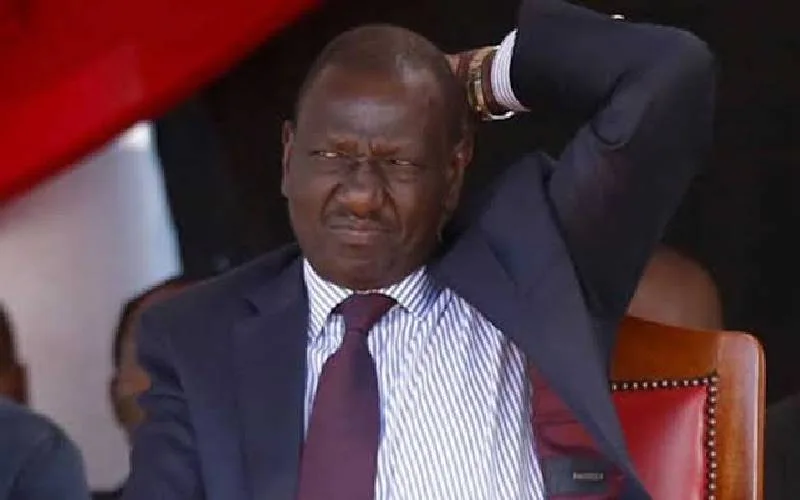
What was expected to be a celebration of Maa culture, unity and heritage turned chaotic as groups of supporters confronted one another at Sekenani Gate in Narok West, forcing attendees to flee for safety and disrupting the programme attended by the Head of State.
According to a report by Citizen TV, the confrontation involved supporters associated with Narok Governor Patrick Ole Ntutu and those allied to Narok West Member of Parliament Gabriel Tongoyo, who is reportedly interested in succeeding Ntutu as governor.
Supporters associated with Kajiado Governor Joseph Ole Lenku were also reportedly caught up in the confrontation.
Videos circulating online showed people running in different directions as tensions escalated, with several chairs thrown around and others smashed during the disturbance.
The Standard reported that the confrontation was linked to the contentious 4,700-acre Olkiombo land dispute, which has remained a sensitive issue among sections of the local community.
The publication reported that a group of youths stormed the festival venue wearing caps bearing the slogan 'Melo Olkiombo', meaning Olkiombo will not be grabbed.
The confrontation reportedly involved stones and traditional Maasai rungus, leaving more than 10 people injured and requiring hospital treatment.
The violence occurred approximately 500 metres from the venue where President Ruto was scheduled to launch the Maasai Women Ushanga Curio Hall.
According to The Standard, security concerns forced the President to delay his entry into the venue as the situation was brought under control.
The incident also attracted the attention of Narok Governor Patrick Ole Ntutu and Senator Ledama Olekina, who intervened and appealed to the rival groups to stop fighting.
Ntutu reminded those involved that they belonged to the same community and urged them not to allow political differences to undermine their shared identity.
The Star also reported on the confrontation, highlighting how the clashes disrupted the cultural gathering and forced attendees to scamper for safety.
Meanwhile, People Daily reported that security officers from the Presidential Escort Unit and the General Service Unit moved in to reinforce security around the President as the programme resumed.
The incident was not the only moment of political tension witnessed during the celebrations.
In another dramatic development, nominated Senator Hezena Lemaletian found herself at the centre of an exchange with Narok Senator Ledama Olekina while addressing President Ruto.
People Daily reported that Olekina appeared to reach for Lemaletian's microphone as she delivered remarks concerning divisions within ODM.
Lemaletian had used a basket analogy to describe what she considered unequal treatment among ODM leaders, warning the President that there were problems within the administration.
Her remarks attracted attention from sections of the audience and added another political dimension to the gathering.
K24 Digital also reported on the aftermath of the confrontation, publishing footage showing two Maasai men cutting up a UDA-branded cap with a machete.
However, the publication cautioned that the video did not establish why the men destroyed the cap or whether their actions represented the wider Maasai community.
Following the intervention of local leaders and security officers, calm was restored and the festival programme continued.
The incident has nevertheless brought renewed attention to the political and land-related disagreements affecting parts of Narok County.
It also raises questions about the growing competition among local political leaders as preparations for the 2027 General Election gather momentum.
For President Ruto, the confrontation provided an uncomfortable interruption to an event intended to celebrate the cultural identity and unity of Maa-speaking communities.
The bigger question now is whether the latest confrontation will prompt further discussions about the Olkiombo land dispute and the political differences that have increasingly featured in the region.
Comments
No approved comments yet.