

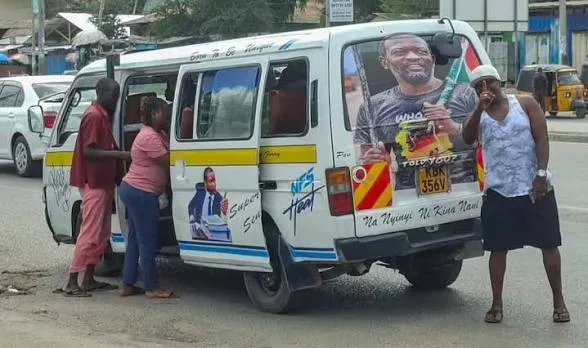
A photograph of the matatu emerged on Sunday morning, November 1, and was shared by communication strategist Pauline Njoroge, who is associated with the Linda Mwananchi movement.
The vehicle features a prominent portrait of Sifuna alongside the Swahili phrase Rais Wa Wananchi, meaning President of the Citizens.
It also carries the phrases Na Nyinyi Ni Kina Nani and the famous question popularised by the late former Prime Minister Raila Odinga, Who Told You?
The branding has attracted attention because of Sifuna's growing political profile and his association with the Linda Mwananchi movement.
The development has also generated mixed reactions on social media, with some Kenyans interpreting the matatu's appearance as a sign of growing grassroots support for the Nairobi senator.
One social media user suggested that by December, matatus across the country could be carrying Sifuna's portraits, reflecting the excitement among some of his supporters.
However, others questioned whether such displays of political enthusiasm would translate into actual votes during an election.
The incident has also drawn attention to Kenya's matatu culture, where public service vehicles have increasingly become platforms for expressing political opinions, celebrating popular personalities and displaying political messages.
Politicians have previously featured on matatu artwork, with vehicle owners using creative designs to reflect popular political movements and public sentiment.
Interestingly, the appearance of the Sifuna-branded matatu coincided with the senator's grassroots tour of Kwale County on Sunday, November 1, as part of the Linda Mwananchi movement's expansion along the Coast.
The movement, which recently established its national headquarters in Nairobi, has been conducting grassroots mobilisation activities as it seeks to build a wider political following.
For Sifuna's supporters, the matatu branding could be interpreted as another indication that his political influence is extending beyond Nairobi.
However, whether the growing public attention surrounding his name will translate into meaningful political support remains to be seen.
As the 2027 General Election approaches, developments such as the Mombasa matatu branding demonstrate how popular culture, public transport and political mobilisation are increasingly intersecting in Kenya's political landscape.
The bigger question is whether Sifuna's growing visibility on the streets will eventually translate into political influence at the ballot.


Comments
No approved comments yet.