
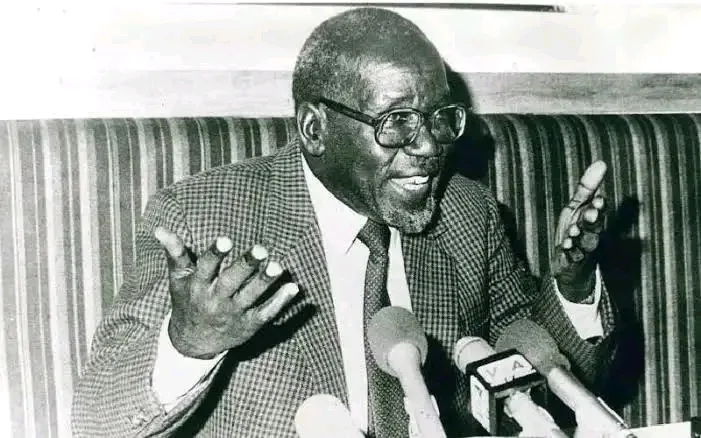
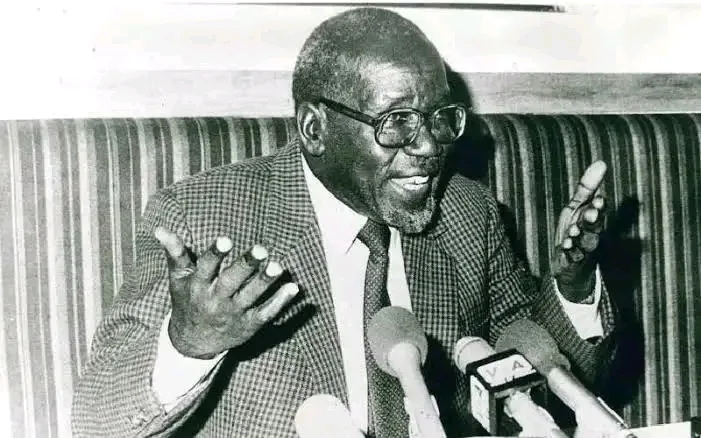
From his entry into colonial politics in 1957 to his involvement in the campaign that restored multiparty democracy in 1991, Muliro built a reputation as a politician who was not afraid to disagree with those in power.
He served under Kenya's first President, Jomo Kenyatta, but his political convictions eventually brought him into direct confrontation with the government. His relationship with his former political ally, Daniel arap Moi, also deteriorated as he became increasingly critical of the country's political direction.
However, it was his final political chapter in 1992 that left one of the biggest questions in Kenya's political history: Could Masinde Muliro have united the opposition and changed the outcome of the country's first multiparty presidential election?
From a teacher to one of Kenya's influential political figures
Born on June 30, 1922, in Matili village in present-day Bungoma County, Muliro rose from humble beginnings to become one of the most influential politicians of his generation.
He received his early education in Kenya and Uganda before joining the University of Cape Town in South Africa in 1949, where he studied history, philosophy and education.
During his stay in South Africa, Muliro became increasingly interested in politics and the struggle against racial discrimination. He also became involved in the African National Congress, where he encountered the wider struggle for African political liberation.
He returned to Kenya in 1954 with his wife, Mercia, and worked as a teacher, including at Siriba Teachers Training College.
His political ambitions, however, soon took precedence.
In 1957, Muliro resigned from teaching and contested the North Nyanza seat in the colonial Legislative Council, defeating incumbent Wycliffe Works Waswa Awori.
His election marked the beginning of a political career that would see him become a leading voice in Kenya's independence movement and post-independence politics.
How Muliro helped establish KADU and championed Majimboism
One of the defining chapters of Muliro's political career was his involvement in the formation of the Kenya African Democratic Union (KADU) in 1960.
Working alongside Ronald Ngala and Daniel arap Moi, Muliro helped establish KADU as an alternative to the Kenya African National Union (KANU).
While KANU advocated for a strong central government, KADU supported a federal system popularly known as Majimboism.
The arrangement was intended to give regional governments greater authority and protect communities that feared domination by larger ethnic groups.
Ronald Ngala became KADU's president, Muliro served as vice-president, while Moi was its chairman.
The disagreement over the country's future governance structure became one of the most significant political debates during the independence negotiations.
Although KADU lost the 1961 general election, Muliro remained influential and served in the transitional government as Minister for Commerce, Industry and Communications.
Following Kenya's independence, KADU eventually dissolved in 1964, with its members, including Muliro, joining KANU.
However, his decision to join the ruling party did not mean he abandoned his independent political convictions.
The 1969 showdown: Why Muliro opposed the banning of Oginga Odinga's KPU
Muliro's willingness to challenge the government became particularly evident in 1969 when the Kenyatta administration moved to ban the Kenya People's Union (KPU), led by Jaramogi Oginga Odinga.
The government had become increasingly hostile towards the opposition party following a violent confrontation at a political rally involving President Kenyatta.
When the motion to ban KPU was presented, Muliro emerged as the only member of the ruling party to oppose it.
Although he condemned the incident involving the President, he argued that banning an opposition party would undermine Kenya's democratic credentials.
He reportedly warned that such a decision would make Kenya the laughing stock of Africa.
The government eventually banned KPU, effectively turning Kenya into a de facto one-party state.
Muliro's position demonstrated an important distinction in his political philosophy: he could disagree with an opposition leader without supporting the suppression of that leader's political organisation.
It was a principle that would define much of his later political career.
The J.M. Kariuki murder controversy that cost him his ministerial position
Perhaps one of the most defining moments in Muliro's political life came in 1975 following the murder of popular politician Josiah Mwangi Kariuki, popularly known as J.M. Kariuki.
The murder triggered national outrage and raised serious questions about the conduct of powerful individuals within the government.
Parliament subsequently debated a report connected to investigations into the killing.
Muliro, who was serving as Minister for Co-operatives and Social Services, took a position that put him directly against the government.
According to a 1992 obituary published by The Independent, he was the only minister who voted against the government over the report.
His vote swung the balance, resulting in the government losing the motion.
The consequences were immediate.
President Kenyatta dismissed Muliro from his ministerial position, and he never regained a Cabinet position.
His dismissal became one of the clearest demonstrations of his willingness to sacrifice political power rather than compromise on an issue he considered important.
Rather than retreating from politics, Muliro continued challenging government policies from Parliament's back benches.
How Muliro became a thorn in Moi's government
When President Kenyatta died in 1978, Daniel arap Moi assumed the presidency.
Interestingly, Moi and Muliro had previously worked together in KADU, but their political relationship became increasingly strained.
Muliro lost his Kitale East parliamentary seat in the 1979 general election amid allegations of electoral manipulation.
He remained outside Parliament for several years before returning through a by-election in 1984 after successfully challenging the previous election outcome.
His relationship with the Moi administration continued to deteriorate as he criticised the ruling party's approach to elections and parliamentary independence.
By the mid-1980s, Muliro was openly accusing the government and KANU of undermining democratic institutions.
He also criticised what he viewed as excessive loyalty to the executive, warning that Parliament was increasingly becoming a rubber stamp for government decisions.
His confrontations with powerful government supporters, including Mombasa politician Shariff Nassir, further demonstrated his unwillingness to remain silent.
The 1988 general election became another difficult chapter.
After Kitale East was split and Cherangany constituency created, Muliro contested the new seat under the controversial mlolongo voting system.
He initially won narrowly, but his election was subsequently nullified.
He lost the resulting 1989 by-election to Kipruto arap Kirwa, marking the end of his parliamentary career.
Despite his electoral setbacks, Muliro remained politically active.
The FORD movement and the struggle to restore multiparty democracy
As pressure mounted against KANU's one-party rule in the late 1980s and early 1990s, Muliro became one of the prominent figures in the campaign for political pluralism.
He worked alongside opposition leaders including Jaramogi Oginga Odinga, Kenneth Matiba, Charles Rubia and Martin Shikuku.
Together, they became associated with the Forum for the Restoration of Democracy (FORD), which mobilised opposition against the continued dominance of KANU.
The campaign faced resistance, arrests, political intimidation and confrontations with security agencies.
However, pressure from opposition leaders, civil society organisations and other pro-democracy groups eventually forced the government to accept constitutional reforms.
In December 1991, Parliament repealed Section 2A of the Constitution, restoring multiparty politics.
FORD subsequently became a political party, with Muliro serving as its vice-chairman.
His experience, political moderation and ability to engage different political personalities made him an important figure in the opposition movement.
The 1992 presidential ambitions that could have changed Kenya's political history
As Kenya prepared for its first multiparty general election in decades, FORD began experiencing internal divisions.
Two of its most influential figures, Oginga Odinga and Kenneth Matiba, were involved in an increasingly bitter struggle over the party's leadership and presidential ticket.
The disagreements threatened to destroy the unity that had brought the opposition together against KANU.
It was against this background that Muliro declared his intention to contest the presidency.
His announcement surprised many political observers because he had previously played a relatively low-key role within FORD.
However, his decision was widely interpreted as an attempt to provide the opposition with a compromise candidate who could bring together competing factions.
An obituary published by The Independent on August 28, 1992, described Muliro as a potential unifying figure who had entered the presidential race when the opposition movement appeared close to disintegration.
The newspaper reported that during a visit to London, Muliro met members of the United Kingdom branch of FORD and indicated that he was willing to relinquish his presidential ambitions if doing so would strengthen opposition unity.
Joseph Gitari, then chairman of UK FORD, was quoted in the obituary describing Muliro as a politician who placed the restoration of democracy above personal ambition.
His intervention came at a critical moment when the opposition needed unity to mount a serious challenge against President Moi.
However, the internal disagreements persisted, and FORD eventually split into FORD-Kenya, associated with Oginga Odinga, and FORD-Asili, associated with Kenneth Matiba.
Muliro's sudden death at Nairobi airport
On August 14, 1992, Kenya lost one of its most experienced opposition politicians.
Muliro collapsed and died at Jomo Kenyatta International Airport shortly after returning from a visit to London.
He was 70 years old.
His death came at a particularly sensitive moment, just months before the December 1992 general election.
A Reuters report published by The Independent on the day of his death described him as a crucial figure in efforts to resolve divisions within FORD ahead of the country's first multiparty elections in 26 years.
His death was attributed to cardiac arrest.
However, the circumstances surrounding his sudden death attracted considerable public and political attention.
A subsequent report by The Independent on August 24, 1992, highlighted questions raised by opposition leaders about the circumstances of his death, including the absence of a post-mortem examination.
His doctor maintained that Muliro had died of natural causes.
Although speculation surrounding his death persisted, allegations of foul play were never established as fact.
His passing left the opposition without a respected political negotiator who had been attempting to bridge the divisions between its leading personalities.
What Kenya lost when Masinde Muliro died
The December 1992 general election was eventually won by President Moi, who secured another term in office.
The opposition's divisions weakened its ability to challenge KANU, with Matiba and Odinga contesting against one another rather than rallying behind a single candidate.
It is impossible to establish whether Muliro would have won the presidency had he lived.
However, his political experience, relationships across different political factions and reputation as a compromise candidate made him an important figure in the opposition's unity efforts.
His death removed a leader who had repeatedly demonstrated an ability to challenge political power without abandoning the principles of democratic competition.
The enduring political legacy of Masinde Muliro
More than three decades after his death, Muliro remains an important figure in Kenya's political history.
His contribution went beyond the struggle for independence. He was also part of the generation that challenged the concentration of political power and fought to restore multiparty democracy.
His political journey offers several lessons about leadership, accountability and political tolerance.
He disagreed with Oginga Odinga but opposed the banning of KPU. He served under Kenyatta but was willing to vote against his government over the J.M. Kariuki murder report. He worked with Moi in KADU but later became one of his critics.
Perhaps the most striking aspect of his political history was his reported willingness to abandon his own presidential ambitions if doing so would preserve opposition unity.
His legacy continues to resonate in Western Kenya and across the country, particularly in discussions about political integrity, democratic accountability and the importance of strong opposition movements.
The Masinde Muliro University of Science and Technology in Kakamega was also named in his honour.
For a politician who spent much of his life challenging those in power, Muliro's greatest political test came in 1992, when he attempted to unite those who wanted to replace them. His death left that mission unfinished and deprived Kenya of a potential opposition consensus leader at one of the most consequential moments in its political history.
Comments
No approved comments yet.