

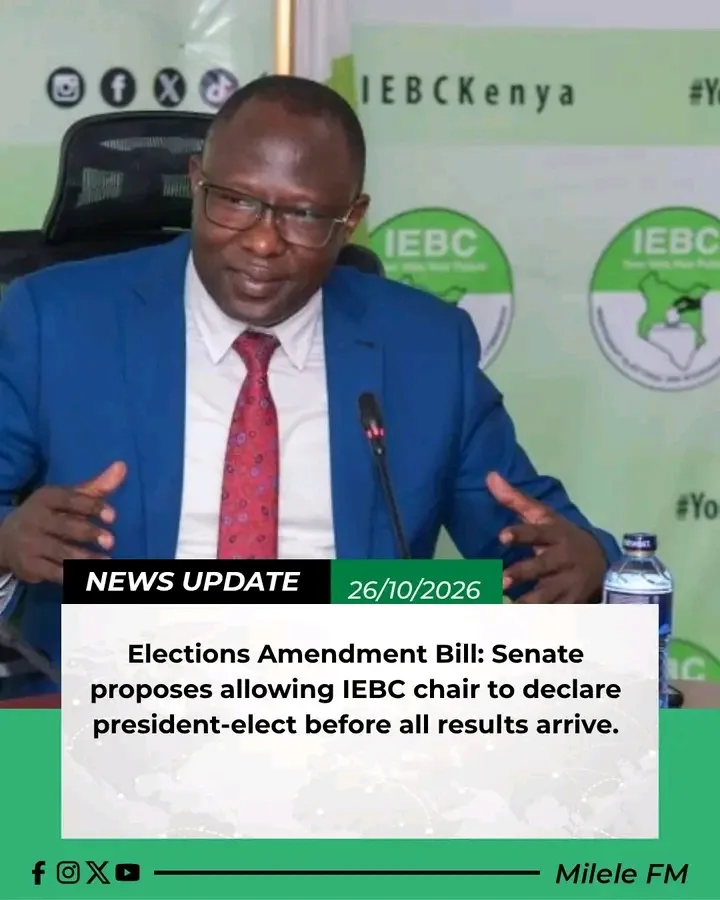
The Senate has proposed changes to Kenya’s election laws that could allow the Independent Electoral and Boundaries Commission (IEBC) chairperson, Erastus Edung Ethekon, to declare a presidential candidate the winner before results from all constituencies have been received.
Under the Senate version of the Elections (Amendment) (No. 2) Bill, 2024, the proposed amendment to Section 39 of the Elections Act would allow the IEBC chairperson to declare a winner if the outstanding results cannot change the outcome of the presidential election.
The proposed clause states:
“The Chairperson may declare a candidate elected as the President before all the constituencies have transmitted their results if the Commission is satisfied that the results that have not been received will not affect the result of the election.”
The Senate passed its version of the Bill in December 2024. However, the National Assembly deleted Clause 22, which sought to introduce the change, when it passed its version of the legislation on Thursday, October 22, 2026.
The Bill has consequently returned to the Senate for further consideration under Article 110(4) of the Constitution, which provides for resolving disagreements between the two Houses over legislation.
Other proposed changes include requiring presidential election results to be tallied, announced and declared before results for other elective positions.
The Bill also proposes requiring the IEBC to electronically transmit results to constituency and national tallying centres within two hours of their declaration at polling stations. It further proposes publishing Form 34As on a public online portal and granting public access to information about election technology within three days.
Another contentious provision seeks to remove the mandatory requirement for the IEBC to livestream election results from polling stations.
The proposal has attracted public debate, with President William Ruto addressing the controversy on Sunday, October 25, 2026. Speaking at AIC Kasina Church in Mwingi, Kitui County, he dismissed claims that livestreaming had been banned as “nonsense propaganda” and defended Kenyans' right to access election results.
The Bill is not yet law. Its final wording remains subject to the legislative process, making the outcome of the Senate's next consideration significant as Kenya prepares for the 2027 General Election.



Comments
No approved comments yet.