
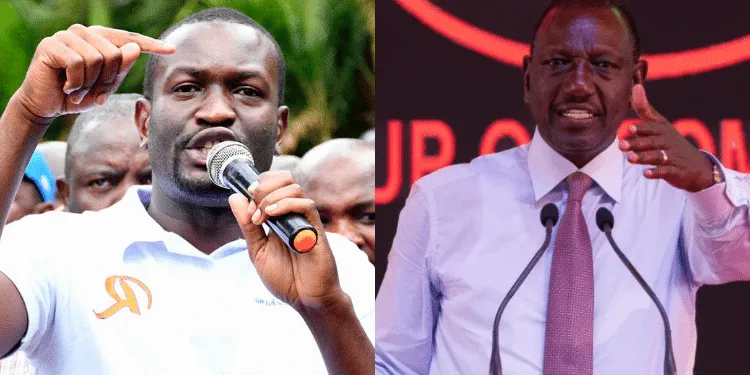
Sifuna has increasingly positioned himself as a potential presidential contender, with his national profile growing through rallies, political meetings and efforts to consolidate opposition support.
His rise has also been reflected in opinion polling, although the available surveys tell different stories depending on how the questions are asked and how the respondents are sampled.
The most striking result came from a July Politrack Africa online exercise, which tested a hypothetical two-person contest between Sifuna and President William Ruto.
Sifuna received 56.3 per cent of the responses against Ruto's 43.7 per cent.
However, the exercise was conducted online and was not a representative scientific opinion poll. Kenya Poll Watch, which reproduced the result from TUKO, specifically notes that online polls measure participation rather than providing scientific election forecasts.
That distinction becomes important when the Politrack figure is compared with more recent nationwide surveys.
Ruto still ahead in latest national survey
A Bobea Report survey conducted between August 26 and September 2 placed Ruto at 35.2 per cent among respondents asked about their preferred presidential candidate.
Sifuna followed at 19.1 per cent, ahead of former Interior Cabinet Secretary Fred Matiang'i at 14 per cent and Wiper leader Kalonzo Musyoka at nine per cent.
The survey also found 17.7 per cent of respondents undecided.
Bobea said its research used random sampling across markets, villages, estates and workplaces nationally. The reported margin of error was plus or minus 3.1 percentage points at a 95 per cent confidence level.
The numbers therefore do not show Sifuna ahead of Ruto nationally, but they do place the Nairobi senator ahead of several established opposition figures in that particular survey.
Sifuna's rise inside the opposition
The clearest evidence of Sifuna's changing position comes from TIFA's June survey.
Ruto remained at 24 per cent, while Sifuna climbed to 15 per cent, overtaking Kalonzo, who stood at 13 per cent.
Matiang'i was at 14 per cent.
TIFA's survey involved 2,048 randomly selected adults interviewed face-to-face across all 47 counties, with a margin of error of plus or minus 2.18 percentage points.
The pollster described Sifuna as recording the fastest growth among opposition figures, with his support rising from virtually zero in its earlier measurements to 15 per cent in June.
The finding gave Sifuna a new position in the opposition contest, even though Ruto remained the leading individual candidate in the survey.
The political question is now bigger than the polls
While Sifuna's polling numbers have attracted attention, his biggest test may be whether he can translate his growing personal following into a durable political organisation.
Linda Mwananchi has been holding consultations with several opposition figures as leaders debate how to approach the 2027 election.
Sifuna has met Kalonzo Musyoka, while Linda Mwananchi leaders have also engaged Fred Matiang'i and other opposition figures.
The discussions have raised questions over whether the opposition will eventually settle on one presidential candidate or continue operating through multiple political vehicles.
That question has become particularly significant as different parties and movements seek a role in the emerging opposition arrangement.
Kalonzo-Sifuna question
Another recent development has shifted attention from Sifuna's presidential numbers to the possibility of him playing a different role within an opposition ticket.
An Infotrak survey reported in September placed Sifuna prominently among preferred running-mate choices for Kalonzo in a hypothetical united opposition arrangement.
A report on the survey said Sifuna emerged as the most preferred deputy-presidential option for Kalonzo among the names tested.
The development illustrates how quickly the political calculations around Sifuna are changing.
At one point, polling attention was focused on whether he could overtake other opposition figures. The latest discussions increasingly involve the question of how his political base could fit into a wider coalition.
Gachagua also leaves the door open
Former Deputy President Rigathi Gachagua has also publicly indicated that he could support Sifuna if opposition leaders agreed on him as their candidate.
That possibility has added another layer to the negotiations involving Linda Mwananchi and the wider opposition.
The political landscape therefore remains fluid, with Sifuna, Kalonzo, Gachagua and Matiang'i each retaining distinct political bases and ambitions.
Recent reporting has also highlighted disagreements within Linda Mwananchi over the political vehicle and leadership structure that should carry the movement into the 2027 election.
From July poll sensation to September political test
The July Politrack result generated one of the most eye-catching numbers associated with Sifuna's presidential ambitions: 56.3 per cent against Ruto's 43.7 per cent in a hypothetical online head-to-head contest.
But that figure should not be presented as evidence that a representative national poll has placed Sifuna ahead of Ruto.
The more recent nationwide Bobea survey put Ruto at 35.2 per cent and Sifuna at 19.1 per cent, while TIFA's earlier national survey recorded Ruto at 24 per cent and Sifuna at 15 per cent.
What the available data does show is a noticeable increase in Sifuna's measured support among opposition politicians.
The political developments surrounding him have moved just as quickly.
From leading street-level mobilisation through Linda Mwananchi to holding talks with other opposition principals and attracting former senior politicians into his camp, Sifuna is now operating in a much larger political arena than he was at the beginning of 2026.
The next phase will depend on how the emerging opposition political vehicles are organised, whether the various camps can agree on a common presidential formula and whether Sifuna's growing support can be sustained as the 2027 election approaches.
For now, the polling presents two different measurements: Sifuna has recorded significant growth within the opposition field, while the available representative national surveys cited above continue to place Ruto ahead of him in overall presidential preference.
With the opposition still negotiating its political structure, the numbers remain snapshots of public opinion rather than an indication of the eventual 2027 election result.

Comments
No approved comments yet.