

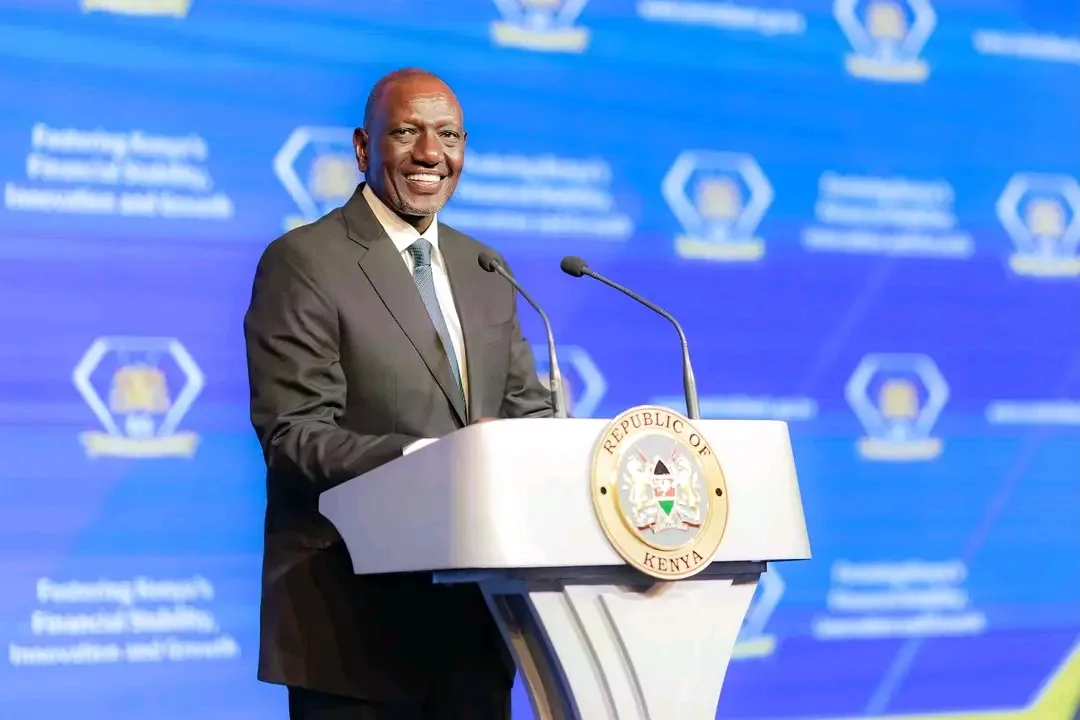
Ruto said the Central Bank of Kenya (CBK) had played a critical role in protecting the country’s financial system and navigating economic pressures that had affected Kenya at different times.
Speaking on Thursday, September 17, 2026, during celebrations marking the 60th anniversary of the Central Bank of Kenya at the Institute of Monetary Studies in Nairobi, Ruto praised the apex bank for its management of the country’s monetary and financial environment.
“The Central Bank of Kenya has done an exceptional job of safeguarding the stability of our financial system and steering the economy through the volatility and pressures we have experienced at one time or another,” Ruto said.
The President pointed to the stability of the Kenyan shilling, moderating inflation and stronger foreign exchange reserves as indicators of the country’s improved economic position.
“Today, that work is reflected in a more stable exchange rate, with the shilling trading at about KSh129 to the US dollar,” he said.
The CBK’s latest data shows the shilling trading at about KSh129.62 against the US dollar on September 17. The regulator also lists Kenya’s August 2026 inflation rate at 6.6 per cent.
Ruto highlights $15.25 billion forex reserves
Ruto also highlighted Kenya’s foreign exchange reserves, which recently climbed to approximately $15.25 billion.
“And inflation moderating to 6.6 per cent in August,” Ruto said, adding that “our foreign exchange reserves [have reached] a historic high of $15.25 billion.”
CBK data showed that foreign exchange reserves stood at about $15.253 billion in the week ending September 10, equivalent to 6.3 months of import cover. The reserves had risen from $14.882 billion a week earlier.
The reserve position provides a significant foreign currency buffer for the country. CBK says it seeks to maintain reserves equivalent to at least four months of import cover.
However, the latest $15.25 billion position is slightly below the approximately $15.4 billion level recorded in late July, meaning the September figure is not the highest level recorded during 2026.
President Ruto turns focus to cheaper credit
With the government highlighting improved monetary and foreign exchange stability, Ruto said the next priority should be ensuring that ordinary Kenyans and businesses feel the benefits through improved access to financing.
“Having secured this foundation of stability; it is now time to translate it into tangible benefits for ordinary Kenyans,” the President said.
He specifically challenged commercial banks to respond by reducing the barriers to accessing credit.
“Our banking sector must respond by making credit more affordable and accessible,” Ruto said.
According to the President, more affordable credit would have wider implications for households, entrepreneurs and the labour market.
He said cheaper and more accessible financing would enable “households [to] invest, businesses [to] expand, jobs [to] be created and our economy [to] grow.”
The call comes as lending costs remain an important issue for borrowers. CBK’s latest published figures put the average lending rate at 14.39 per cent in July 2026, while the Central Bank Rate stood at 8.75 per cent as of August 11.
CBK has also been working on a risk-based credit pricing framework intended to improve how banks price loans. However, CBK Governor Kamau Thugge said on September 17 that the implementation of the framework had been affected by renewed economic pressures linked to the Middle East crisis.
CBK marks 60 years
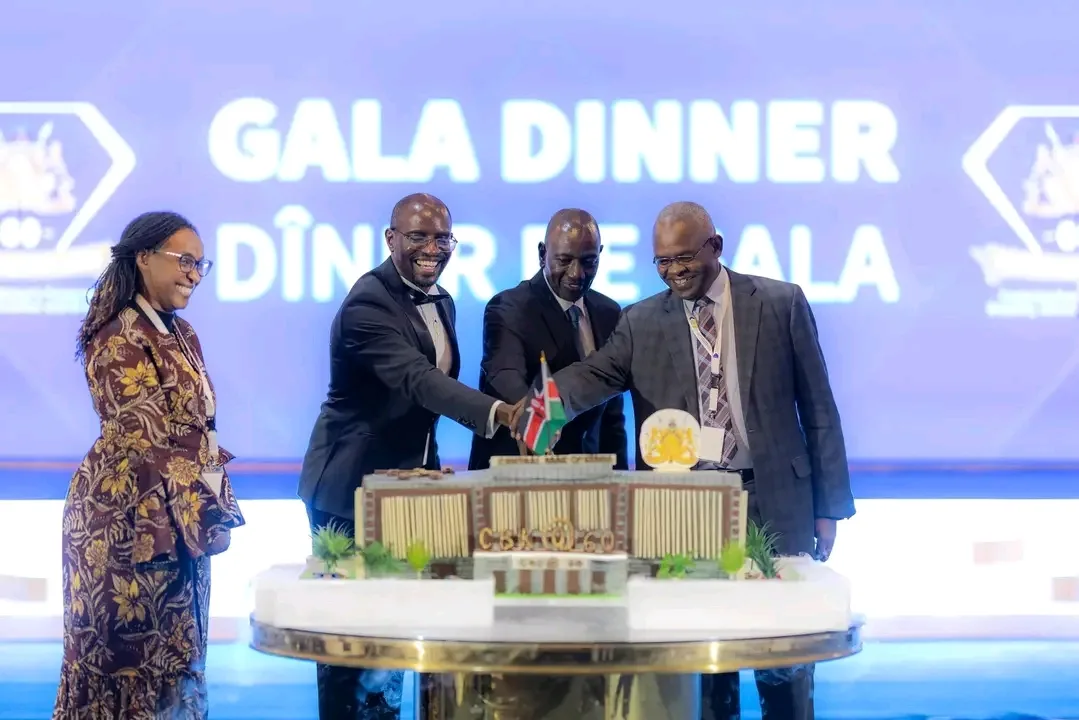
Ruto’s remarks came as the Central Bank of Kenya marked 60 years since its establishment.
The CBK was established on September 14, 1966, and is marking its Diamond Jubilee with a series of events and high-level engagements in Nairobi. The anniversary programme is being held alongside the 2026 Annual Meetings of the Association of African Central Banks.
The celebrations have brought together central bankers, financial-sector leaders, researchers and other stakeholders to discuss monetary policy, financial stability and the future of Africa’s financial systems.
Ruto used the anniversary occasion to recognise the role of the CBK while simultaneously setting out expectations for the banking sector.
“The Central Bank of Kenya has done an exceptional job,” the President said.
But he added that maintaining macroeconomic stability should ultimately be reflected in the daily economic experiences of Kenyans.
“It is now time to translate it into tangible benefits for ordinary Kenyans,” Ruto said.
His message to the banking industry was therefore centred on credit: “making credit more affordable and accessible” to households and businesses.
The President linked that objective directly to investment, business expansion and employment, saying that improved access to financing would help create the conditions for “jobs to be created and our economy to grow.”
As Kenya marks six decades of central banking, the debate is therefore shifting from stabilising key economic indicators to how that stability can translate into lower borrowing costs, greater access to finance and increased economic activity.
Do you want to be published? E-mail info@thedailywhistle.co.ke or WhatsApp 0721930260




Comments
No approved comments yet.