

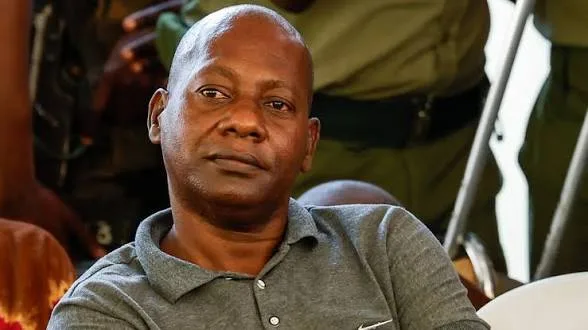
Self-proclaimed preacher and Shakahola cult leader Paul Nthenge Mackenzie has been sentenced to 200 years in prison for his role in the deaths of 191 people, including 190 children, at Shakahola Forest in Kilifi County.
The sentence was delivered on Friday, November 6, 2026, by High Court Judge Diana Kavedza Mochache at the Mombasa High Court.
Citizen Digital reported that Mackenzie, the founder of Good News International Church, received two separate 100-year prison terms for the murders committed between January 2021 and September 2023.
The sentencing followed his conviction on 191 counts of murder, making the ruling a major development in one of Kenya's deadliest religious-related tragedies.
Daily Nation also reported that the court distinguished between victims who died through starvation and those who were killed through direct physical violence.
According to the publication, Mackenzie received 100 years for 183 counts of murder by starvation, involving 182 children and one adult. He received another 100 years for eight counts of murder by direct homicide involving children.
The judge directed that the sentences within each category run concurrently, while the two categories would run consecutively, resulting in an aggregate sentence of 200 years.
The Standard and The Star also reported on Friday that the court handed Mackenzie the lengthy prison sentence following his conviction over the Shakahola deaths.
The decision came after prosecutors urged the court to impose the death penalty, arguing that the scale and brutality of the killings deserved the harshest possible punishment.
However, Judge Kavedza declined to impose the death sentence.
Daily Nation reported that the judge explained that executing Mackenzie could undermine the intended punishment because of the religious beliefs associated with the crimes.
She observed that individuals who regard death as a pathway to heaven and reunion with Jesus could perceive capital punishment as a triumph rather than a penalty.
The judge maintained that the seriousness of the offences required a sentence that reflected the suffering of the victims and the magnitude of the crimes.
Reuters and CNN also reported on the court's decision, highlighting the unusual circumstances surrounding the sentencing and the judge's explanation for rejecting the death penalty.
The court established that Mackenzie used religious teachings to persuade followers to abandon conventional social institutions and relocate to Shakahola Forest, where they were instructed to fast to death in the belief that they would meet Jesus.
According to Citizen Digital, the court found that Mackenzie promoted an extreme belief system that encouraged followers to reject formal education, modern healthcare and government institutions.
The prosecution presented evidence showing how the teachings were used to control followers and enforce the deadly fasting programme.
The court further established that children were expected to die first, followed by young people, women and men.
Those who resisted the instructions were subjected to violence, restraint and confinement, according to evidence presented during the proceedings.
Mackenzie was not the only person sentenced over the massacre.
Citizen Digital and KBC reported that his 28 co-accused also received lengthy prison terms for their involvement in the crimes.
Fifteen co-accused were sentenced to 160 years each, while another 10 received 140-year prison terms.
One convict received 100 years, while two others were sentenced to 10 years each.
Among those sentenced was Mackenzie's deputy, Smart Mwakalama, who received a cumulative prison term of 160 years.
The sentences marked the conclusion of a major phase of the criminal proceedings involving the deaths of 191 people.
The Shakahola tragedy first attracted national attention in March 2023 after authorities began investigating reports of followers starving themselves to death in a remote settlement within Chakama Ranch.
The discoveries led to large-scale exhumations at Shakahola Forest, where hundreds of bodies were subsequently recovered.
The Standard reported on October 19 that Mackenzie and his 28 co-accused had been convicted of murdering 191 people following a lengthy trial.
NTV Kenya also reported on the conviction, highlighting the deaths of 190 children and one adult and the court's decision to deliver sentences on November 6.
The prosecution presented 120 witnesses during the trial, while the defence called nine witnesses.
Meanwhile, People Daily reported on Friday that the Directorate of Criminal Investigations welcomed the sentencing, describing it as an important milestone in the pursuit of justice for the victims and their families.
The investigative agency maintained that the ruling demonstrated that individuals who exploit religion to commit serious crimes would be held accountable.
Despite the 200-year sentence, Mackenzie still faces other legal proceedings relating to separate allegations connected to the Shakahola tragedy and other suspected deaths.
Reuters reported that authorities recovered 448 bodies from Shakahola Forest, while Mackenzie faces a separate case involving 52 deaths at another location. The suspected overall death toll linked to the wider tragedy has been put at approximately 500.
Mackenzie's lawyer, Lawrence Obonyo, has indicated that the defence intends to challenge the ruling through an appeal.
The sentencing therefore marks a significant development in a case that shocked Kenya and attracted international attention.
For families who lost their children and relatives, the ruling represents an important step towards accountability, although no prison sentence can restore the lives lost in the tragedy.
Do you think the 200-year sentence handed to Paul Mackenzie is sufficient punishment for the Shakahola massacre, or should the court have imposed the death penalty? Share your views in the comments.


Comments
No approved comments yet.