

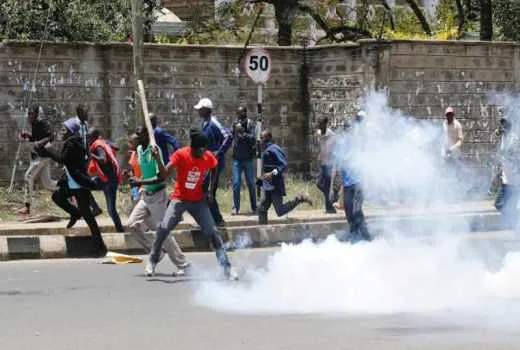
From Nairobi streets, where a viral video appeared to show a woman being attacked in broad daylight, to political convoys that have descended into chaos, Kenyans are increasingly asking a difficult question: If political tensions are already rising this early, what could happen when the country gets closer to the 2027 vote?
The comparison with 2007 is particularly uncomfortable.
But Kenya is not in another 2007.
The country has a new Constitution, a more assertive Judiciary and institutions that have undergone significant reforms since the disputed 2007 presidential election.
Still, the warning signs being discussed by Kenyans and political observers deserve attention.
2007 vs 2027: The Number 7 That Scares Everyone
On paper, 2007 and 2027 share little beyond the number seven.
Politically, however, the comparison has become difficult to ignore.
The 2007 General Election was followed by widespread violence that left more than 1,000 people dead and displaced hundreds of thousands of others. The crisis became one of the darkest chapters in Kenya’s post-independence history.
Two decades later, Kenya is again approaching a highly contested election, with political alliances shifting, public distrust growing and confrontations increasingly playing out at rallies and on social media.
That does not mean Kenya is destined for another 2007/08 crisis.
But it does raise a question that the country's political leaders, security agencies and electoral institutions cannot afford to ignore:
Are the current warning signs being addressed early enough?
Why 2027 Is Raising Alarm Before the Vote
One of the biggest differences between 2007 and 2027 is timing.
In 2007, the most serious violence erupted after the presidential election results were announced.
Today, concerns about political violence are emerging well before Kenyans head to the ballot box.
Several recent incidents involving political gatherings and convoys have intensified the debate.
1. Political rallies turning into confrontations
Political events in different parts of the country have recently been disrupted by confrontations, with injuries and deaths reported in some incidents.
Former Deputy President Rigathi Gachagua’s Democratic Congress Party (DCP) convoy was reportedly attacked in Nakuru, raising fresh questions about the safety of political leaders and their supporters.
Days later, chaos was reported in Homa Bay during a Linda Mwananchi convoy. Police said two people, including a police officer, died during the disturbances.
Such incidents are particularly worrying in a country where political violence has historically been closely associated with election periods.
The key question is whether these are isolated confrontations or signs of a broader escalation in political intolerance.
2. The return of ethnic rhetoric
Ethnic politics was one of the most explosive features of the 2007 election crisis.
Today, social media has created a new and much faster avenue through which inflammatory statements can spread.
Recently, claims circulated online alleging that Health Cabinet Secretary Aden Duale made remarks referring to the Kikuyu community.
The claims generated significant debate on Facebook and X.
However, the remarks circulating online have not been independently verified, and Duale has not been established to have made the alleged comments based on the material circulating publicly.
That distinction matters.
In an era where edited videos, misleading captions and unverified claims can reach millions of people within hours, misinformation itself can become a political flashpoint.
The reaction to the alleged remarks, however, demonstrates just how sensitive ethnic language remains in Kenya.
3. Growing concerns over insecurity
Another issue increasingly dominating public debate is insecurity.
Videos circulating on social media have shown violent incidents in public places and during political gatherings, while reports of masked individuals and confrontations at political events have raised questions about who is behind some of the disturbances.
The National Police Service has previously said investigations into incidents of political violence are ongoing.
But social media clips alone cannot establish the identity, motive or organization of those involved.
That is why transparent investigations and timely communication from security agencies are crucial.
If Kenyans are left to rely entirely on unverified videos and political claims, fear and suspicion can spread much faster than facts.
IEBC and the Trust Question
Security is not the only issue generating anxiety ahead of 2027.
Electoral transparency is another.
Questions surrounding the Independent Electoral and Boundaries Commission (IEBC) have periodically resurfaced, particularly over the transmission and publication of election results.
Reports have also circulated about proposals concerning the commission’s role in broadcasting or publishing results during the counting process.
Such claims need to be treated carefully.
Any proposed change to election procedures should be examined through the actual legislation or parliamentary record rather than social media claims.
For many Kenyans, however, the broader issue is trust.
The 2007 election demonstrated the devastating consequences that can follow when large sections of the public lose confidence in an electoral process.
For 2027, the credibility of the IEBC will therefore be just as important as the final results themselves.
The Court and the 2027 Election Date
Legal questions surrounding the timing of the next General Election have also contributed to the political conversation.
A petition has challenged the constitutional basis of the 2027 election date and sought judicial intervention over when Kenyans should go to the polls.
However, there has been no final court determination changing the constitutionally scheduled 2027 election date.
For now, the next General Election remains scheduled for August 10, 2027, in accordance with the constitutional framework.
The legal debate is nevertheless significant because uncertainty surrounding the election timetable can create unnecessary political tension.
What Is Different About Kenya in 2027?
There are important reasons not to assume that history will simply repeat itself.
Kenya adopted a new Constitution in 2010, introducing significant institutional and legal reforms.
The Judiciary has also played a more prominent role in electoral disputes, including the historic decision to annul the 2017 presidential election and order a fresh vote.
The country also has considerably more experience dealing with contested elections, constitutional petitions and electoral disputes than it did in 2007.
At the same time, the political environment has changed dramatically.
Social media now plays a central role in political mobilization.
A confrontation captured on a mobile phone can become a national story within minutes.
Political misinformation can spread faster than official responses, while inflammatory statements can reach millions of Kenyans without passing through traditional media gatekeepers.
That creates a new challenge for the country ahead of 2027.
So, Is 2027 Another 2007?
Not yet—and there is no basis for declaring that Kenya is heading for another 2007/08 crisis.
The comparison should therefore be treated as a warning rather than a prediction.
Kenya today has stronger constitutional safeguards and institutions than it did two decades ago.
But institutions can only work effectively when political leaders respect them, security agencies act impartially, electoral officials maintain public confidence and citizens reject violence.
The early signs of political confrontation, ethnic rhetoric, misinformation and insecurity should therefore not be dismissed.
Neither should they be exaggerated into proof that another national crisis is inevitable.
The real lesson from 2007 is that political tensions become dangerous when they are allowed to escalate unchecked.
The Bigger Question Ahead of 2027
With the election still months away, Kenya has time to prevent history from repeating itself.
Political leaders have a responsibility to discourage violence and inflammatory rhetoric.
Security agencies must investigate attacks impartially and hold perpetrators accountable regardless of political affiliation.
The IEBC must maintain transparency and communicate clearly with the public.
And Kenyans themselves must be careful about sharing unverified claims that could inflame ethnic or political tensions.
The question is therefore not simply whether 2027 will become another 2007.
The more important question is whether Kenya will learn enough from 2007 to ensure that it never gets close to repeating it.
For now, the country is at a crossroads.
The warning signs are there. The outcome, however, is not predetermined.

Comments
No approved comments yet.